

HMS Scylla Wreck Penetration: A Survivor’s Account and the Lessons Every Diver Should Hear
Wreck diving has a unique pull. The history, the atmosphere, the technical challenge, and the privilege of exploring a ship that now sits as an artificial reef can feel like the pinnacle of UK diving. But in the same breath, wreck penetration is one of the most unforgiving forms of diving there is—especially when visibility collapses, exits disappear, and time becomes a hard currency measured in bar.
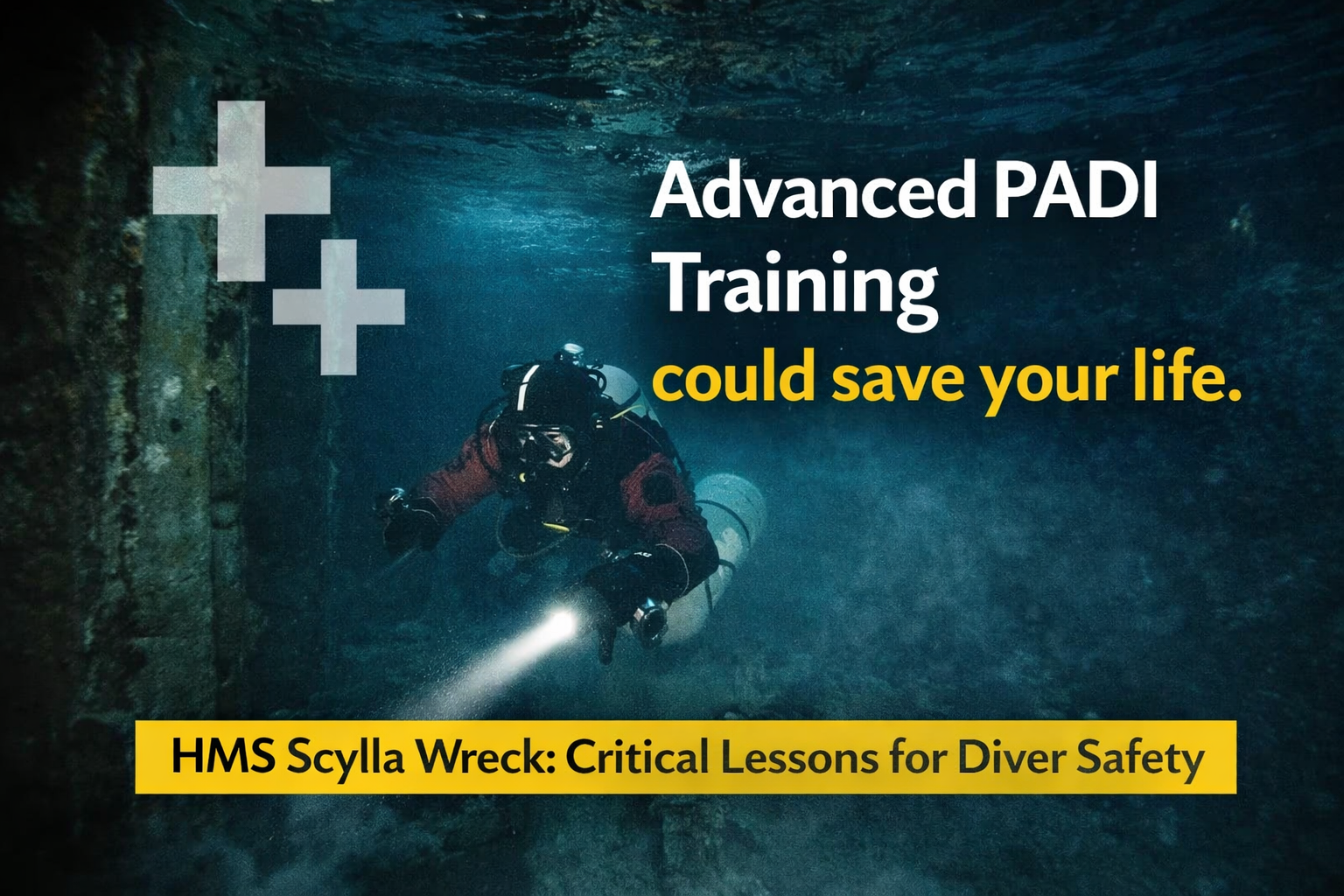
On 3rd September 2021, three experienced divers descended onto the wreck of HMS Scylla off the coast of Cornwall. They entered the wreck and penetrated deep into the ship, moving down to deck three and into the engine-room area. Inside the silty, confusing corridors, something went wrong. Two divers, tragically, did not make it out. A third diver, Adam Dent, survived by the narrowest of margins.
In the embedded video below, Adam sits down to explain—step by step—what happened, what he believes contributed to the situation, the decisions that ultimately saved his life, and the warning he wants every diver to take seriously.
This is a difficult watch, but it is also an important one. It is not presented for shock value. It is presented because real learning in diving often comes from honest, uncomfortable truths—and because one conversation can change how someone plans, trains, and executes their next dive.
Watch the Interview (Embedded Video)
A Clear Reminder: “It Can Happen to Anyone”
One of the most striking themes in Adam’s account is not panic—it’s realism.
He describes the gradual shift from “we’ve got a problem” to “we have an actual issue,” and the moment where denial gives way to understanding that the dive has moved into an emergency. He speaks openly about complacency—how experience can sometimes create comfort that quietly erodes caution—and how easy it is to believe that certain outcomes “won’t happen to me.”
That mindset is one of the most dangerous hazards in wreck diving, because it reduces the perceived need for the simple safeguards that exist for a reason.
The Environment: Why HMS Scylla Can Bite Hard
HMS Scylla is a well-known UK wreck, intentionally sunk to form an artificial reef and popular with divers. It has large cut-outs and is often dived with the expectation that, if you become disorientated, you can eventually find a route back to one of those openings.
However, Adam’s story highlights a key point: expectation is not a plan.
Even in wrecks divers “know,” internal layouts can become confusing quickly—especially when you move into areas you have not personally dived before. Add tight spaces, multiple divers, and silt, and the environment can change from navigable to hostile in minutes.
The Core Failure Mode: Disorientation + Silt-Out
Adam describes how, after turning around, the exit he expected simply wasn’t there. Whether it was a wrong turn, a missed corridor, or the visual sameness of the internal structure, the result was the same: confusion in a space where confusion is expensive.
As the search continued, visibility deteriorated. The silt was not necessarily caused by poor technique—he is clear that the space itself was so tight that with three divers inside, a silt-out was effectively inevitable. Once the silt blooms, the wreck becomes a brown-out world where torches illuminate only what your hand can touch.
At that point, the dive stops being “wreck exploration” and becomes a survival problem involving:
-
navigation without vision
-
breathing control under extreme stress
-
and decision-making when time and gas are both collapsing
The Decision to Separate: A Real-World Dilemma
At a critical stage, Adam made a conscious choice to separate from the other two divers—reasoning that additional eyes searching different routes could increase the chance of finding an exit.
This is one of the most sobering parts of the account, because it highlights how real emergencies force decisions that don’t fit neatly into a training slide. The principle of staying together exists for sound reasons; equally, wreck emergencies sometimes create competing priorities between searching, conserving gas, and maintaining contact.
This is not presented here as “right” or “wrong.” It’s presented as reality—and as a reminder that the best time to reduce complex decisions is before the dive, through conservative planning, line discipline, and clear team protocols.
The Survival Elements That Stand Out
1) Breathing Control Under Adrenaline
Adam describes the fight between brain and body: the physiological urge to breathe fast versus the conscious requirement to slow down. This is a fundamental wreck-penetration skill that cannot be improvised in the moment. If you are going to enter overhead environments, you must be able to actively manage stress breathing.
2) Gas Awareness and Mental Discipline
He recounts watching pressures drop, switching cylinders, and thinking through how he might avoid drowning if the worst happened. That level of clarity under pressure is rare—and it underlines why overhead training emphasises gas planning, reserves, and redundancy.
3) Persistence Without Panic
A key point: he accepted the seriousness of the situation—but did not stop trying. He continued searching with purpose rather than freezing, which ultimately led to finding an alternative exit.
4) Reducing Profile to Escape
The escape itself required removing equipment to fit through a tight opening. This is an extreme scenario, but it reinforces a principle: in overhead environments, you must plan around restrictions and consider what happens if the normal exit route is not available.
The Most Important Lessons for Wreck Penetration Divers
This is the part every diver should take away and apply—not as theory, but as operational discipline.
1) Treat “Easy Penetration” as Still Overhead
If you cannot go directly up, it’s overhead. That means overhead protocols apply—even if the wreck is popular, has cut-outs, or “everyone does it.”
2) Always Plan the Exit, Not the Entry
Entry is easy. Exit is everything. Plan your exit route, your turnaround pressure, and your contingencies with the assumption that visibility could go to zero.
3) Use a Continuous Guideline Where Appropriate
One of the recurring post-incident discussions in wreck diving is line use. Adam himself acknowledges that not running a line is something he reflects on. The deeper point is this: your guideline is not there for “when you’re lost.” It’s there to prevent “lost” from being possible.
4) Gas Planning Must Assume Delays
Even a short penetration can become long. Gas planning must allow for delays, stress breathing, and the time required to locate an exit if the layout becomes confusing.
5) Fitness Matters More Than Many Divers Admit
Adam points out that fitness affected his consumption and his ability to stay calm. This is not cosmetic. In overhead environments, fitness is a safety margin.
6) Calm is a Skill, Not a Personality Trait
If you are relying on “I’ll stay calm,” you are relying on hope. Calm under pressure comes from repetition, training, and exposure to controlled stress scenarios.
7) Write an Account Early After Trauma (If You Can)
A powerful practical tip mentioned: writing down a factual account soon after an incident can help prevent memory gaps and allow more accurate debriefing later.
A Note on Community and Aftercare
Adam speaks candidly about survivor’s guilt and the psychological weight that followed. If you’ve never experienced a serious diving incident, it can be hard to grasp how long it can echo.
Diving communities can be exceptional at support—when they show up properly. This is also a reminder that mental health after incidents is part of safety culture, not separate from it.
If you or someone you dive with has been affected by a serious incident, consider speaking to a qualified professional and lean on the support structures available through your local dive community and relevant organisations.
Final Thought: Respect the Wreck, Respect the Process
The Scylla is not “dangerous” in the abstract. What’s dangerous is the combination of overhead environment, limited margins, and human assumptions. This story is a reminder that the ocean doesn’t negotiate—and wrecks don’t forgive.
If this interview causes even one diver to:
-
run a line when they might not have,
-
turn a dive earlier,
-
add redundancy,
-
improve fitness,
-
or rethink penetration planning,
then sharing it has real value.